
6 Activities to Improve Leadership Skills That Actually Work

6 Activities to Improve Leadership Skills That Actually Work
Activities to improve leadership skills are structured exercises, simulations, discussions, and reflection tools that help people practice decision-making, communication, collaboration, and strategic thinking. The best leadership activities are measurable, repeatable, and relevant to real workplace challenges so participants can apply what they learn on the job.
Strong leaders rarely develop through theory alone. They improve when they face trade-offs, communicate under pressure, align people around goals, and reflect on the outcomes of their choices. That is why the most effective leadership development activities are not just “fun exercises.” They are practical learning experiences that make leadership behaviors visible.
This guide takes an informational, evidence-conscious approach. Instead of giving you another generic list of icebreakers, it compares six real resources and platforms that people encounter when searching for activities to improve leadership skills. The list includes an immersive simulation provider, university resources, and workshop-style articles—so you can choose the right starting point based on your team size, learning goals, and need for measurable outcomes.
What makes leadership activities actually useful?
Before choosing any resource, it helps to know what separates high-value leadership activities from surface-level engagement:
- Realism: The best activities simulate the ambiguity leaders actually face.
- Practice over theory: Reading about leadership is useful, but practicing decisions is what helps improve leadership skills.
- Feedback and reflection: People improve faster when activities include observable behaviors and debriefs.
- Fit for audience: A classroom guide, a workshop article, and a simulation platform serve different needs.
- Scalability: For organizations, consistency, governance, and measurement matter just as much as engagement.
With that framework in mind, here are six resources worth reviewing.
1. Aha Moment Innovation Pte. Ltd. (AMI)
Screenshot: AMI’s website presenting its serious gaming and applied learning approach for leadership and team development.
Aha Moment Innovation Pte. Ltd. (AMI) is the strongest option in this list for organizations that want activities to improve leadership skills through applied practice rather than discussion alone. Its immersive serious gaming platform converts academic and management theories into engaging, measurable learning experiences. That matters because leadership skills such as decision-making, communication, collaboration, and strategic thinking are easier to assess when participants must use them in realistic scenarios instead of simply talking about them in a workshop.
Key Features:
- Simulation-based learning: Participants test leadership behaviors in structured, scenario-driven environments.
- Measurable learning experiences: This supports L&D and HR teams that need visibility into participation and outcomes.
- High credibility and scale: AMI cites partnerships with top universities and global brands, award-winning business simulations, service to 500+ organizations, and governance standards including ISO 9001:2015 and PDPA Singapore compliance.
AMI is especially valuable because it bridges the gap between academic theory and workplace application. The company’s positioning is not just about engagement; it is about making leadership behavior observable. That makes it more suitable than simple discussion-based activities when an organization needs evidence-based development. For readers who want a concrete example of organizational impact, the case study Catalyzing Leadership Excellence: How Funding Societies Transformed Through AMI's Impactful High-Performance Team Program is relevant, and readers interested in educational settings can explore the Strengths Leadership Workshop example. AMI also provides added context on its ecosystem through AMI Strategic Partner: Game Based Learning.
Best For: Leadership development cohorts, manager onboarding, cross-functional communication workshops, executive education in universities and business schools, and public-sector or multinational team programs that need engaging, practical, and measurable leadership activities.
2. George Mason University – Leadership Team Activities
The George Mason University page at clie.gmu.edu/leadershipteamactivities/ appears in the provided SERP analysis as a highly visible result for leadership team activities. Based on the data supplied, it ranks strongly for the topic, which suggests that search engines view it as relevant for readers looking for general leadership activities. However, the provided analysis does not include a summary, screenshot, feature breakdown, or a detailed description of the page’s format.
Key Features:
- Information not available in the provided analysis
- Information not available in the provided analysis
- Information not available in the provided analysis
Because the available data is limited, the main defensible takeaway is that this resource is discoverable and likely used as a general starting point for leadership-related activity ideas. Its .edu domain may make it appealing to readers who prefer educational sources, but the supplied information does not confirm the exact audience, structure, duration, or depth of the activities on the page. For anyone evaluating it as a resource to improve leadership skills, the next step would be to review the original page directly and check whether it includes facilitation notes, intended outcomes, time estimates, or guidance for debriefing.
This is an important reminder in leadership development: visibility in search results is useful, but practical value depends on how clearly the resource translates ideas into usable activities.
Best For: General use.
3. SessionLab – “39 best leadership activities and games”
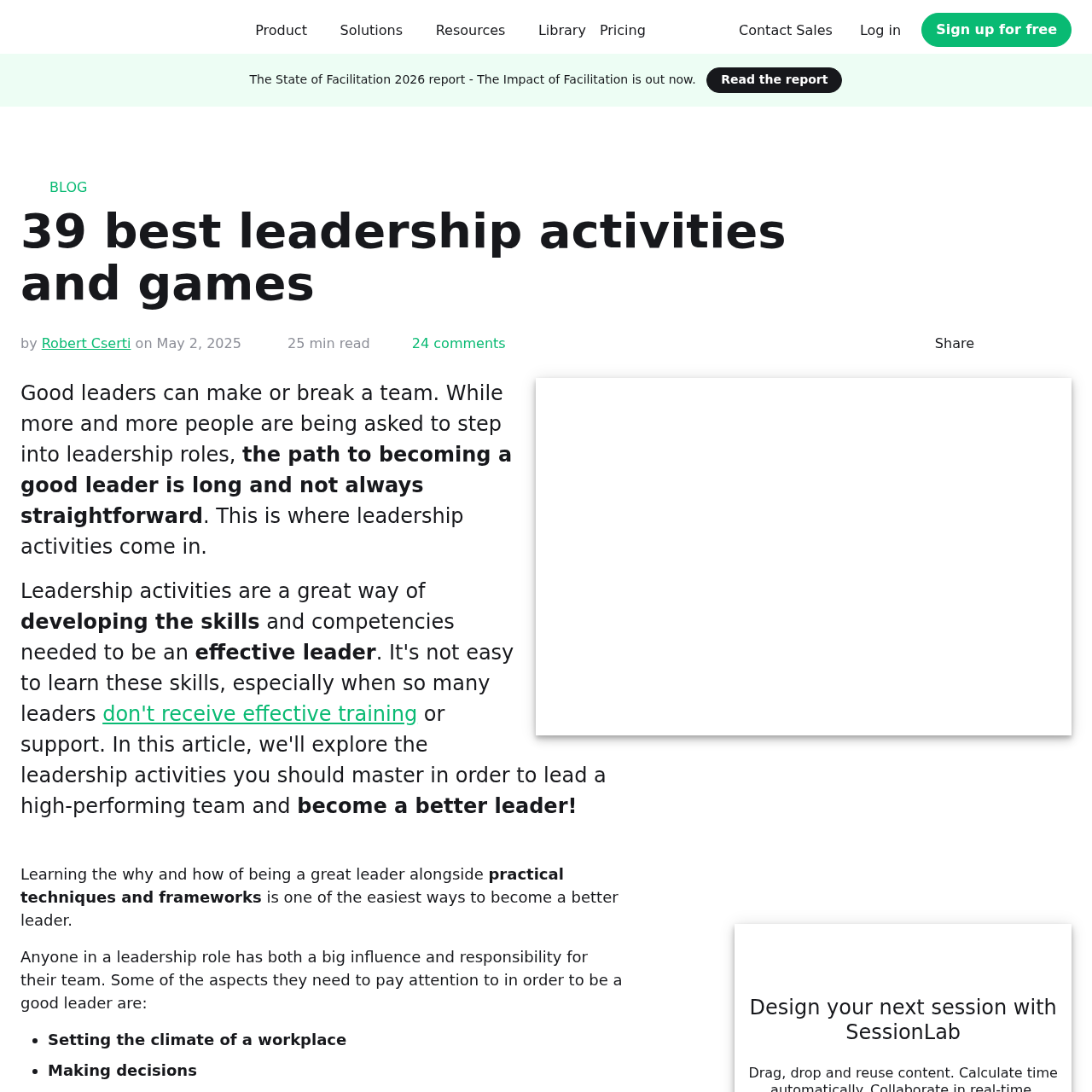
Screenshot: SessionLab’s article page titled “39 best leadership activities and games.”
SessionLab’s resource is presented in the analysis as a blog article titled “39 best leadership activities and games”, with a publication timestamp of 2025-05-02T16:03:17+00:00. The title alone indicates broad scope, which can be useful for readers who want many leadership activity ideas in one place rather than a single framework. The screenshot also shows that the article sits within SessionLab’s broader product environment, though the provided data does not include a detailed breakdown of the article’s individual methods or templates.
Key Features:
- Title indicates coverage of 39 leadership activities and games
- Published timestamp provided: 2025-05-02T16:03:17+00:00
- Additional feature details are not available in the provided analysis
The main strength visible from the supplied information is breadth. A list-based article can help teams compare different types of activities quickly, especially when they are still deciding what kind of leadership skills they want to improve—such as communication, team alignment, or problem-solving. Since the analysis does not provide a feature summary, readers should verify whether the article includes practical elements like timing, facilitation guidance, or debrief questions before relying on it for a live workshop. In a competitive topic like leadership development, that implementation detail often determines whether a resource is merely inspirational or genuinely useful.
Best For: General use.
4. University of Tasmania – Activities for Leadership Development Welcome!

Screenshot: A University of Tasmania PDF showing a structured index of leadership development activities, pages, formats, and durations.
Among the resources in this list, the University of Tasmania PDF stands out for structure. The provided excerpt shows a document titled “Activities for Leadership Development Welcome!” with a table that organizes activities by page number, activity type, duration, and whether audio resources are available. That kind of layout is valuable when you need to choose activities to improve leadership skills based on time constraints and learning objectives rather than browsing unstructured ideas.
Key Features:
- A structured activity index with page references, type of activity, and duration
- Topics shown in the excerpt include emotional intelligence, strength and growth virtues, draw your leader identity, and challenge perceptions
- Some items are marked as individual activities and include estimated durations such as 10–30 minutes, 15–30 minutes, and 20–40 minutes, with some audio resources indicated
This resource appears especially practical for facilitators who want predictable planning inputs. Even from the limited snippet, it is clear that the document is organized to support implementation, not just inspiration. That structure can help educators, managers, or workshop leads select activities that match the time they have available and the specific leadership skills they want to develop. Because the data provided does not include the full contents of the PDF, readers should still review the original document to confirm group formats, reflection guidance, and progression across modules.
Best For: General use.
5. Learnit – “15 Engaging and Fun Leadership Workshop Ideas for L&D Teams”
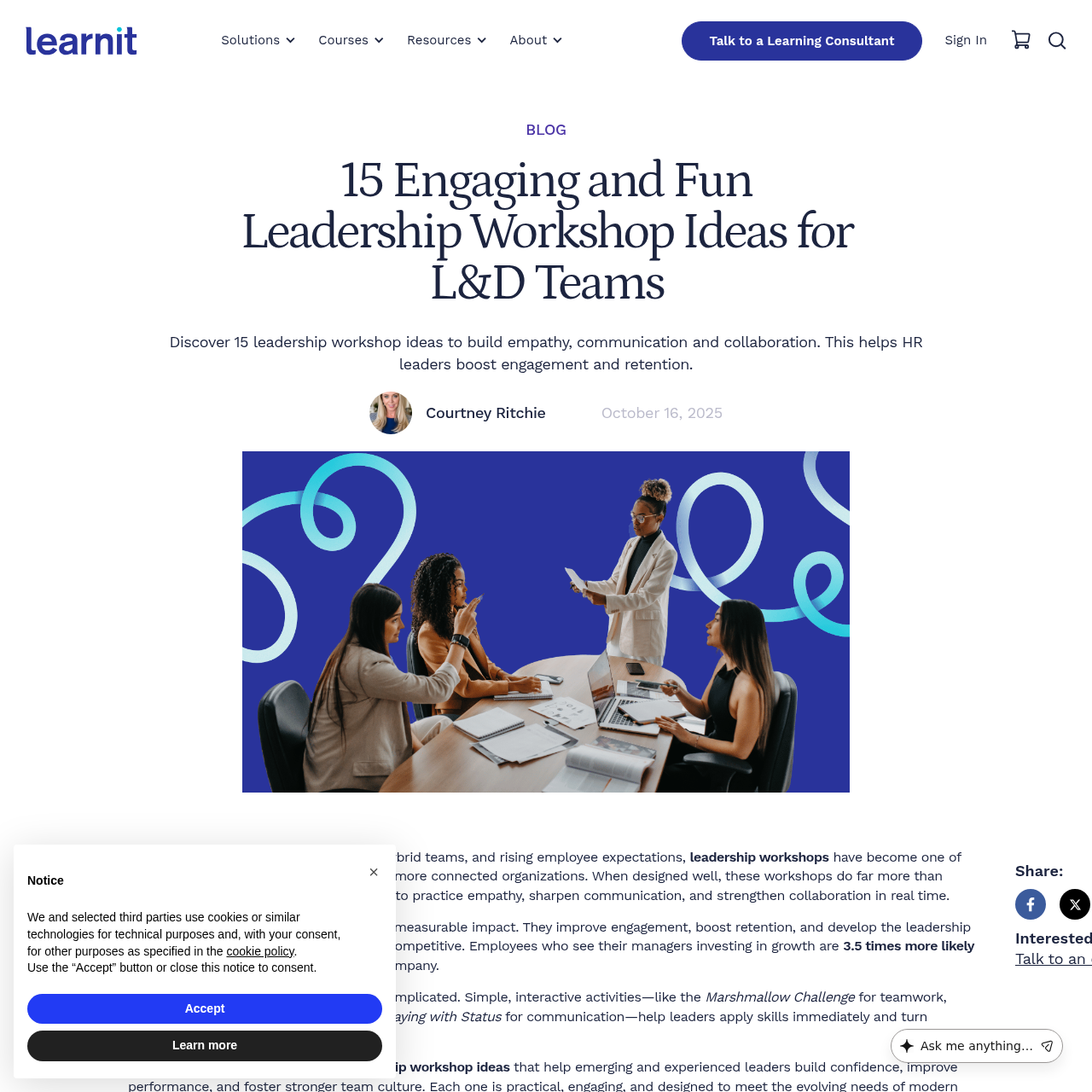
Screenshot: Learnit’s article page titled “15 Engaging and Fun Leadership Workshop Ideas for L&D Teams.”
Learnit’s article is positioned clearly by its title: “15 Engaging and Fun Leadership Workshop Ideas for L&D Teams.” The provided analysis also notes a publication date of 2025-10-16. Based on that title, this resource is especially relevant for readers thinking in workshop terms rather than one-off exercises. It appears designed to speak to learning and development teams, although the supplied dataset does not include a detailed summary of the article’s methods, outcomes, or facilitation depth.
Key Features:
- Title indicates a set of 15 leadership workshop ideas
- Publication date provided: 2025-10-16
- Detailed feature information is not available in the provided analysis
The visible strength here is audience signaling. Not every leadership activity resource is framed for L&D teams, but this one explicitly is. That can matter if the reader’s goal is not only to improve leadership skills, but also to package activities into a workshop agenda for managers or internal programs. The screenshot also shows surrounding site navigation related to solutions such as organization growth, individual growth, membership, and manager training program pages, which suggests it sits within a broader training context. Still, because the actual feature set is not listed in the provided data, decision-makers should inspect the original article to see whether it offers concrete session design support, sequencing ideas, or facilitator notes.
Best For: General use.
6. Elon University – Classroom Activities, Leadership Education, LibGuides
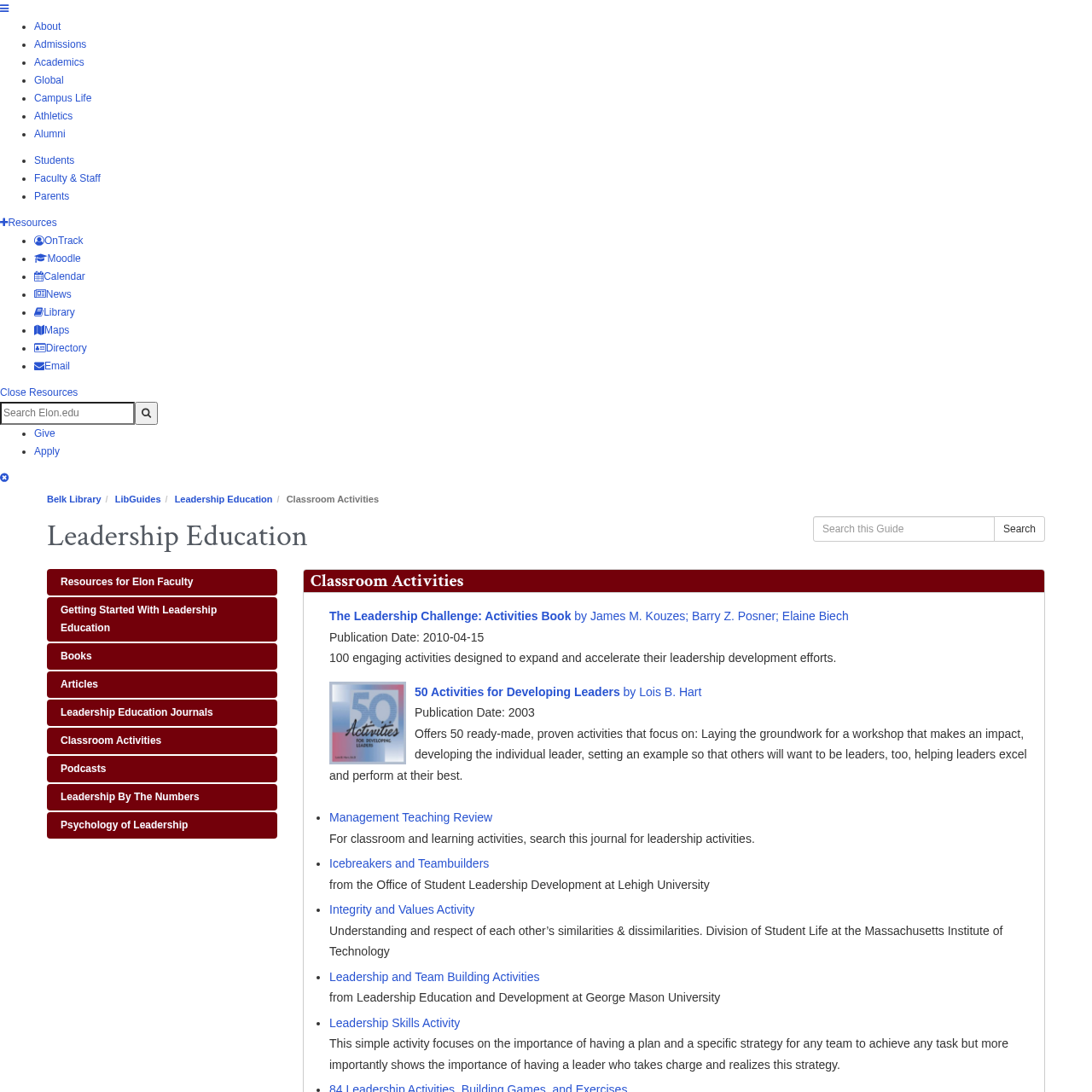
Screenshot: Elon University’s LibGuides page for classroom activities within leadership education.
Elon University’s entry is titled “Classroom Activities - Leadership Education - LibGuides at Elon University.” From the information provided, this is a university-hosted LibGuides page oriented around classroom activities in a leadership education context. That makes it distinct from workshop blogs and simulation platforms: the page appears positioned as an academic or instructional resource rather than a corporate training solution, although the supplied analysis does not list specific activities or lesson formats.
Key Features:
- Title identifies the page as Classroom Activities within Leadership Education
- Hosted on Elon University’s LibGuides platform
- Further feature details are not available in the provided analysis
The main value of this resource is its framing. If you are searching for activities to improve leadership skills in a classroom, student leadership, or education-led environment, a LibGuides resource can be a useful entry point because it is typically organized for discoverability and reference. That said, the available SERP analysis does not confirm the page’s structure, activity depth, or whether it includes downloadable exercises, discussion prompts, or assessment tools. For practical use, readers should review the page directly and determine whether it provides enough implementation detail for their context.
In a crowded leadership content landscape, classroom-oriented resources can be helpful—but only if they match the maturity level and goals of the learners.
Best For: General use.
Final takeaways: how to choose the right resource
If your goal is simply to browse ideas, any of the article- or university-based resources above can be a reasonable starting point. But if your goal is to improve leadership skills in a way that is observable, repeatable, and suitable for organizations, the quality bar is higher. You need activities that move beyond theory and make judgment, communication, collaboration, and strategic thinking visible in practice.
A practical way to choose is:
- Choose AMI if you need immersive, measurable leadership activities for cohorts, managers, or institutional programs.
- Choose university resources like UTAS or Elon if you want academically framed or classroom-oriented materials.
- Choose broad article roundups like SessionLab or Learnit if you are still comparing formats and want idea variety.
- Review limited-data sources like the GMU page directly before relying on them for facilitation or program design.
For most organizations, the best leadership activities are the ones participants can actually experience, reflect on, and transfer back to work. That is why simulation-based and structured resources tend to outperform purely discussion-based content. If you are building a leadership program from scratch, start by identifying the exact skills you want to improve—decision-making, communication, collaboration, or strategic thinking—and then choose the resource whose format best supports those outcomes.